
Garage Floor Moisture Testing in Elkhorn: Why It Matters Before Coating
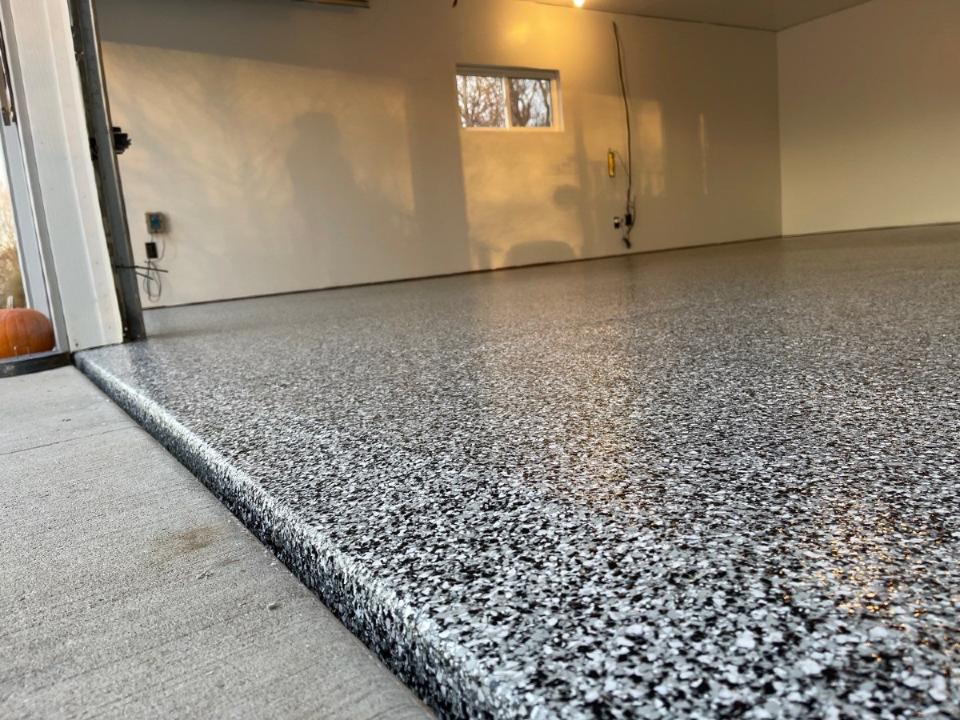
Epoxy and polyurea floor coatings have become one of the most popular upgrades homeowners in Elkhorn make to their garages. It is easy to see why. A coated garage floor looks sharp, resists stains, holds up to vehicle traffic, and is simple to clean. But there is a step that a lot of contractors skip, or do poorly, that leads to coatings peeling, bubbling, and failing well before their time: moisture testing.
If you have ever seen a garage floor coating delaminating in sheets within a year or two of being applied, moisture coming up through the concrete slab is usually the reason. At ConcreteAid, we test every garage floor before we apply any coating, and we want to explain why that step is not optional if you want a coating that actually lasts.
greg beckard – june 10, 2024
What Moisture Testing Is
Concrete is a porous material. Even slabs that look completely dry on the surface can be transmitting moisture vapor from the ground below. This vapor moves up through the slab continuously, and when a coating is applied on top, that moisture has nowhere to go. It builds up at the bond line between the concrete and the coating, and eventually the coating releases.
Moisture testing measures the rate at which water vapor is moving through the concrete slab. The most accurate method is calcium chloride testing, which measures how much moisture is being emitted over a specific time period per square foot. The result is expressed in pounds of moisture emission per 1,000 square feet over 24 hours. Most coating manufacturers specify a maximum moisture emission rate their product can tolerate, and exceeding that threshold means the coating will fail regardless of how well it is applied.
Relative humidity testing, which uses probes inserted into the concrete at specific depths, is another method that gives insight into moisture conditions inside the slab rather than just at the surface. Both methods together give us the clearest picture of what a slab is actually doing before any product goes down.
Learn more about concrete coatings
Common Elkhorn Issues
Elkhorn has some characteristics that make moisture testing particularly important. Much of the development in Elkhorn has happened on former agricultural land, and soils in this area can have significant clay content and variable drainage characteristics. Clay soils hold water and release it slowly, which means even months after rainfall, moisture can still be migrating upward through the ground and into a slab.
Homes built in Elkhorn over the last 20 years tend to have slabs poured on grade with varying levels of vapor barrier quality. Older construction often has no vapor barrier at all, or a barrier that has deteriorated over time. Without an effective vapor barrier between the soil and the slab, ground moisture moves directly up into the concrete with no obstruction.
We also see issues in Elkhorn homes where grading around the foundation has settled or changed over the years, directing surface water toward the structure rather than away from it. When water is pooling against the foundation or near the garage slab edge, moisture readings tend to be elevated along the perimeter of the floor.
Seasonal variation matters too. Spring in Nebraska brings significant precipitation and snowmelt, and slabs that test fine in August may show elevated moisture readings in April or May. For clients in Elkhorn scheduling a coating project, we recommend testing during or after wet weather periods rather than during a dry stretch, because a dry-season test may not reflect the worst conditions the slab will experience.
How It Impacts Coatings
Different coating systems have different tolerances for moisture. Standard epoxy coatings are among the most sensitive and require the slab to be at or below 3 pounds of moisture emission rate before application. Polyurea and polyaspartic coatings are more forgiving and can often be applied at higher moisture levels, which is one reason they have become popular in humid climates.
When moisture levels are elevated, applying a standard epoxy is a gamble that almost always ends badly. The coating may look fine for months, particularly during dry weather. But when moisture conditions change, the coating will start to bubble or delaminate. Once that process starts, the only fix is to remove the coating entirely and start over, which costs more than getting the moisture issue right from the beginning.
For slabs with moderate moisture concerns, moisture-tolerant primers or moisture mitigation coatings can be applied as a base layer before the topcoat. These products penetrate the concrete and block vapor transmission, creating a surface the topcoat can bond to reliably. For slabs with very high moisture readings, we have an honest conversation with the homeowner about what is causing it and whether a more significant intervention is needed before any coating makes sense.
Testing Methods
When we show up to evaluate a garage floor for coating, moisture assessment is one of the first things we do. For a standard two-car garage, we place multiple calcium chloride test kits at different locations across the floor, typically in the center, near the door, and along the back wall. We give the tests the required dwell time before reading results. Rushing this step produces unreliable data.
In addition to calcium chloride testing, we perform a simple plastic sheet test as a preliminary check. Taping a piece of plastic to the floor and leaving it for 24 hours reveals visible moisture if levels are significant. It is not a substitute for quantitative testing, but it gives us a quick read before the more involved setup.
We also look for visual clues: white powdery deposits on the surface, called efflorescence, are a sign that water is moving through the slab and carrying minerals with it. Staining patterns near joints or cracks can indicate water pathways. Peeling or adhesion failures on existing coatings tell us moisture has been a problem in the past. All of these observations go into our assessment before we recommend a coating approach.
Our full Elkhorn NE Concrete Coating offerings detailed here.
Preventing Failures for Coatings in Elkhorn, NE
The best way to prevent coating failures from moisture is to address the root cause rather than just coating over the symptom. If grading is directing water toward the garage, regrading the area around the foundation is worth the investment. If gutters are dumping water near the slab edge, extending downspouts costs almost nothing and makes a meaningful difference. If the original vapor barrier is inadequate or missing, there are mitigation products that can address this from above without excavation.
Proper surface preparation is the other half of the equation. Concrete should be mechanically ground or shot-blasted, not just acid-etched, before any coating is applied. Grinding opens the surface profile and removes any laitance, which is the weak layer of cement paste at the surface that forms during curing. Coating over laitance without proper preparation is another common cause of failure that moisture testing alone will not catch.
Once a coating is properly applied to a well-prepared, moisture-tested surface, the ongoing maintenance is minimal. Keeping the floor clean, addressing small chips promptly before moisture can get under the coating, and recoating the surface every several years as the topcoat wears will keep a garage floor looking great for a long time.
If you are considering a garage floor coating at your Elkhorn home, contact ConcreteAid to schedule a consultation. We will test the floor, give you an honest assessment, and recommend the right system for your specific conditions. Doing it right the first time is always less expensive than fixing it later.
View Epoxy Garage Coatings by ConcreteAid
Ready for an Epoxy Coating in Elkhorn That Won't Peel, Bubble, or Fail?
A garage floor coating is an investment in how your home looks and functions every single day. But that investment only pays off if the prep work is done right. At ConcreteAid, moisture testing is a standard part of every coating project we take on in Elkhorn, not an add-on or an afterthought. We want every floor we coat to still look sharp five and ten years down the road, and that starts before a single drop of coating goes down. If you are ready to finally do something with that garage floor, give us a call. We will assess your slab, walk you through your options, and make sure you get a coating system that is matched to your specific conditions. Your garage deserves to look as good as the rest of your home.