
Concrete-Safe Ice Melt for Omaha Winters: Stop Destroying Your Driveway
Every winter, Omaha homeowners face the same dilemma: how do you keep walkways safe without destroying your concrete? That bag of rock salt from the hardware store seems like the obvious answer, but it’s actually one of the worst things you can use on concrete surfaces. The good news? Understanding which de-icing products actually protect your investment while keeping people safe makes a real difference in how long your concrete lasts. This comprehensive guide breaks down what works, what doesn’t, and how to get through Nebraska winters without wrecking the driveway or walkways you invested thousands of dollars in.
greg beckard – feb 18, 2024
Why Your De-Icing Choices Matter
Concrete seems indestructible after all, it’s literally rock-hard. But it’s actually vulnerable to specific types of damage that common de-icers accelerate dramatically. Understanding this helps you make better choices.
The Science of Freeze-Thaw Destruction
Water gets into the microscopic pores in concrete. Concrete isn’t completely solid it has tiny air pockets and capillary spaces throughout. When temperatures drop below freezing, that water freezes and expands by approximately 9%.
Omaha typically experiences 30-50 freeze-thaw cycles every winter. That’s 30-50 times that water expands and contracts, each cycle creating microscopic cracks that grow larger.
How Rock Salt Accelerates Concrete Destruction
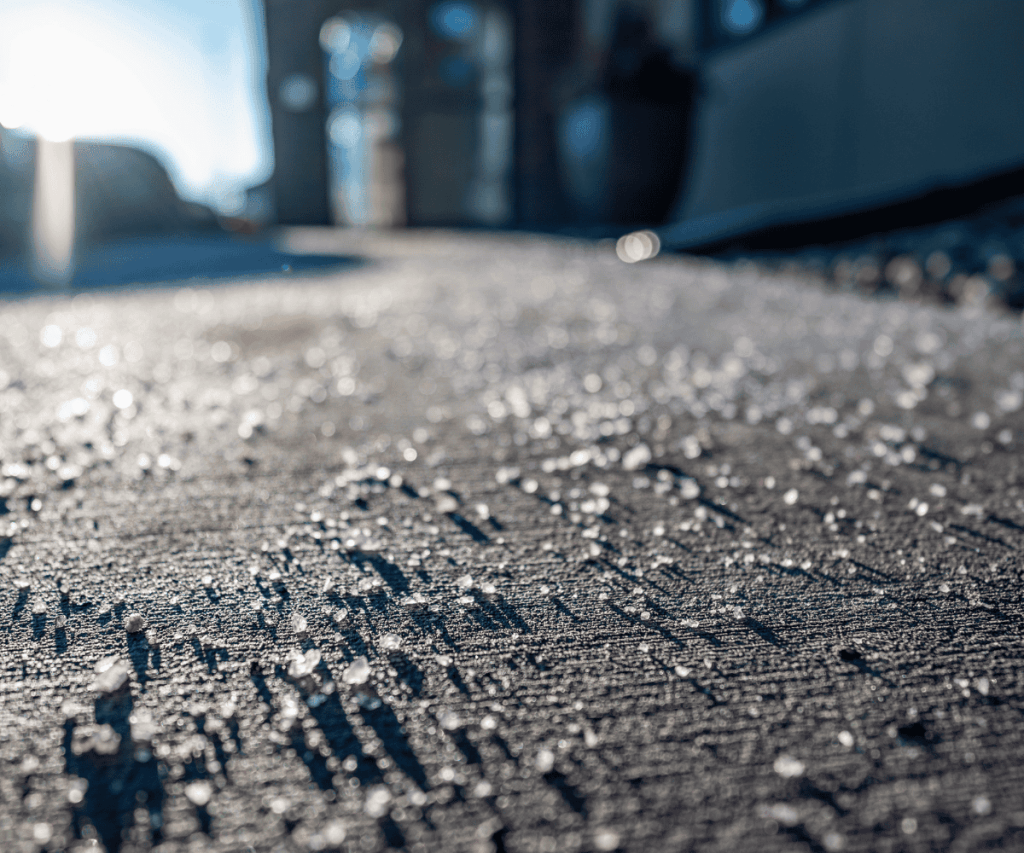
Rock salt (sodium chloride the cheap blue bag at every store) doesn’t just create problems it multiplies them:
1. Salt pulls MORE water into concrete
Rock salt is hygroscopic, meaning it attracts and holds moisture. When you apply salt to your driveway, it doesn’t just melt ice it actively pulls additional moisture from the air into your concrete’s pores.
More water = more freeze-thaw damage. You’re literally increasing the volume of water available to freeze and cause destruction.
2. Salt increases the number of freeze-thaw cycles
Salt lowers the freezing point of water. Pure water freezes at 32°F. Saltwater freezes around 20°F (depending on concentration).
3. Salt chemically attacks concrete
The salt itself chemically reacts with concrete compounds, breaking down the surface layer and causing scaling that flaky, peeling appearance where the top layer of concrete comes off in sheets.
Salt also reacts with the calcium hydroxide in concrete, forming calcium oxychloride. This compound actually expands inside the concrete, creating additional internal pressure and cracking.
4. Salt corrodes reinforcement
If salt penetrates deeply enough to reach rebar reinforcement (common in older or cracked concrete), it causes rust. Rusted rebar expands, creating more internal pressure that cracks concrete from the inside out.
The Real Cost of “Cheap” Rock Salt
Short-term savings vs. long-term costs:
- Rock salt costs: $5-10 per 50-lb bag, maybe $20-40 per winter
- Concrete-safe alternatives: $15-25 per 50-lb bag, $60-100 per winter
- Extra cost for safe products: $40-80 per winter
Damage from rock salt over 10-15 winters:
- Driveway replacement: $5,000-$8,000
- Sidewalk repairs: $800-$2,000
- Patio surface restoration: $1,500-$3,500
- Total damage: $7,000-$13,000
You “saved” $400-800 over those years using rock salt. You caused $7,000-13,000 in damage.
Concrete properly protected from harsh de-icers lasts 30+ years. Concrete exposed to rock salt every winter shows significant damage in 10 to 15 years. The extra cost of better de-icers pays for itself many times over.
For professional concrete installation built to handle Nebraska winters, visit ConcreteAid.
The Over-Salting Problem in Omaha Neighborhoods
The “Just in Case” Mentality
We see this throughout Omaha and Council Bluffs neighborhoods every winter:
Homeowners dump salt before storms or apply heavy amounts “to be safe.” This excessive use doesn’t improve safety but dramatically increases concrete damage.
The reality: Salt only works when ice is actually present. Applying it to dry concrete before a storm just means more chemical exposure with zero benefit. The salt sits there for days, pulling moisture from the air into your concrete, causing damage before any ice even forms.
What ConcreteAid recommends: Apply de-icer AFTER you’ve shoveled, and only use enough to break the ice bond with the concrete surface. You don’t need a thick layer a light, even application is far more effective and less damaging.
Surface damage from excess:
Over-salting accelerates scaling and spalling. That rough, pitted surface where the concrete is flaking away? That’s often from years of excessive salt use.
The white residue you see after winter isn’t just ugly. It indicates salt has penetrated the surface and is causing internal damage you can’t see yet.
Premature cracking:
Concrete weakened by repeated salt exposure cracks more easily from normal stress. Small cracks that would stay stable in healthy concrete widen and spread in salt-damaged surfaces.
Beyond Concrete: The Wider Impact
Environmental damage throughout Omaha metro:
Excess salt doesn’t disappear when ice melts. It washes into:
- Storm drains leading to the Missouri River and local streams
- Groundwater supplies
- Your yard, killing grass and plants
- Neighbors’ properties via runoff
We see it every spring: Stressed trees and dead shrubs lining Omaha sidewalks in neighborhoods with heavy salt use. Brown grass strips along driveways. The runoff into yards kills vegetation this isn’t just a concrete problem, it’s an environmental one affecting your entire landscape investment.
Pet safety concerns: Salt irritates pets’ paws, and they ingest it when licking their feet. Many Omaha veterinarians see salt-related issues every winter.
Vehicle and metal corrosion: Salt accelerates rust on vehicles, metal railings, light fixtures, and anything else it contacts. Garage floors exposed to salt from cars develop accelerated deterioration we see this constantly in garage floor coating assessments.
Your property value: Salt-damaged concrete, dead landscaping, and deteriorated surfaces hurt curb appeal and property values. Buyers notice and factor repair costs into offers.
Practical Non-Chemical Alternatives for Omaha Winters
Sometimes the best solution doesn’t involve chemicals at all.
Sand for traction:
Plain sand provides grip without any chemical reaction with concrete. It works in any temperature and costs almost nothing.
Best uses: Shaded walkways that stay icy all day, extremely cold days when even salt won’t melt ice (below 15 degrees), spots where you need immediate traction.
Application: Sprinkle lightly across icy areas. A little goes a long way. Too much creates mess without additional benefit.
Limitations: Sand doesn’t melt ice. It just gives traction on top. You’ll need to shovel or sweep it up when ice melts. It can track into buildings and scratch floors.
Where to get it: Hardware stores sell “winter sand” or “play sand.” A 50-pound bag costs $5 to $8 and lasts most of the winter for residential use.
Sand and minimal ice melt blends:
Mixing sand with small amounts of concrete-safe ice melt gives you traction plus limited melting action.
Ratio: About 80% sand, 20% ice melt works well. This stretches expensive ice-safe products while still providing some melting.
Benefits: Less chemical exposure than pure ice melt, better traction than pure chemicals, cost-effective compromise.
When to use: Moderate cold (20 to 32 degrees) where some melting helps but pure chemicals aren’t necessary.
Strategic Snow Removal: Your First Line of Defense
The best de-icer is removing snow before it becomes ice. This eliminates 70-80% of chemical use while fully protecting concrete.
1. Shovel early and often
- Clear snow during storms, not after they end
- Every 2-3 inches is ideal
- Light snow is easier to remove than heavy, compacted snow
2. Clear down to the surface
- Remove all snow, don’t just make a path
- Snow left behind melts during the day, refreezes at night
- This freeze-thaw creates the ice problems you’re trying to prevent
3. Prevent compaction
- Don’t walk or drive on snow before removing it
- Compacted snow becomes ice that’s much harder to remove
- Once compacted, you’ll need chemicals; prevent it instead
For comprehensive concrete maintenance guidance, check our residential concrete services.
Concrete-Safe De-Icing Products
When you need actual ice melting power, choose products that won’t destroy your concrete.
What to avoid:
Sodium chloride (rock salt): The cheap blue bag at every store. Terrible for concrete. Works down to about 20 degrees but causes all the damage discussed earlier.
Magnesium chloride: Marketed as “safer” but still damages concrete. Works to lower temperatures (around 5 degrees) but accelerates scaling and corrosion.
Calcium chloride: Very effective at melting (works to around 0 degrees) but highly corrosive to concrete and metal. Creates heat that can cause thermal shock to cold concrete.
Products with these as primary ingredients damage concrete. The bag might say “safe for concrete” but if sodium chloride or magnesium chloride are the main ingredients, it’s marketing, not truth.
Better options:
Calcium magnesium acetate (CMA):
This is the gold standard for concrete-safe ice melting. Developed specifically to be non-corrosive while still melting ice effectively.
Potassium acetate:
Similar to CMA with slightly better performance in cold temperatures. Often used in commercial aviation for de-icing.
Beet juice and brine-based products:
Natural alternatives made from agricultural byproducts mixed with salt brine. The organic compounds lower freezing points while reducing the amount of salt needed.
ConcreteAid’s Product Recommendations by Situation
For typical Omaha residential driveways and walkways: → Calcium Magnesium Acetate (CMA) for best concrete protection
For extreme cold days (below 20°F): → Potassium Acetate or use sand for traction instead
For budget-conscious protection: → Beet juice/brine blends (better than rock salt, more affordable than CMA) mixed with sand
For new concrete (first winter after installation): → Sand only or very minimal CMA; avoid all salt-based products
For decorative or stamped concrete: → Only CMA or potassium acetate; appearance matters too much to risk damage
Special Considerations for Omaha Concrete
Nebraska’s specific climate and concrete types require tailored approaches.
New Concrete (First Year After Installation)
Critical protection period: Concrete takes a full year to reach mature strength and complete curing. First-winter concrete is especially vulnerable to damage.
ConcreteAid’s first-year recommendations:
- NO chemical de-icers at all if possible use sand exclusively
- If you must use chemicals, ONLY CMA or potassium acetate in absolute minimal amounts
- Never use any salt-based products
- Extra diligent shoveling to minimize chemical need
Why this matters: New concrete has more moisture in its pores and hasn’t developed full resistance to freeze-thaw damage. Chemical exposure this first year can cause damage that shortens lifespan by years.
If ConcreteAid installed your concrete: We’ll remind you about first-winter care and provide specific guidance based on your installation date and conditions.
Decorative and Stamped Concrete
Extra care required for colored, stamped, or decorative surfaces:
These finishes involved additional investment and effort protect them accordingly.
Recommendations:
- Only CMA or potassium acetate no exceptions
- Avoid beet juice products that might stain light colors
- Apply even more sparingly than regular concrete
- Consider using sand primarily and chemicals only when absolutely necessary
- Reseal decorative concrete annually to maintain protection
Older Concrete with Existing Damage
If your Omaha concrete already shows scaling, cracking, or deterioration:
Immediate actions:
- Switch to concrete-safe products NOW to prevent additional damage
- Repair cracks before winter to prevent water intrusion and freeze-thaw expansion
- Seal concrete to reduce water absorption
Questions About Concrete-Safe Ice Melt in Omaha
Why don't more people use concrete-safe products if rock salt is so bad?
1. Upfront cost perception: Rock salt costs $5-10, CMA costs $20-30. People see the price difference and choose cheaper without calculating long-term costs.
2. Availability: Every gas station and grocery store carries rock salt. Concrete-safe products require trips to specialty stores or online ordering.
3. Lack of awareness: Most homeowners don’t understand concrete damage until they see it years later. By then, damage is done.
Can I use safe products on concrete and rock salt on asphalt?
Yes, this is actually a smart strategy if you have both surfaces. Asphalt isn’t damaged by salt the way concrete is (though salt does accelerate asphalt deterioration somewhat and certainly corrodes vehicles/metal).
My concrete is already damaged. Is it too late?
Never too late to stop making it worse. Switching to safe products immediately prevents additional damage and can extend remaining lifespan by years.
Get a professional assessment to understand your options. ConcreteAid provides free estimates in Omaha.
Does sealing eliminate the need for safe de-icers?
No, but it significantly reduces damage from any de-icer. Sealer + safe de-icers = maximum protection.
Think of it like sunscreen it doesn’t make sun harmless, but it dramatically reduces damage. Sealer doesn’t make rock salt safe, but it reduces (not eliminates) the damage.
The Bottom Line on Safe De-Icing
Protecting Omaha concrete through winter isn’t complicated, but it requires breaking some common habits:
Stop defaulting to cheap rock salt. The short-term savings guarantee long-term costs.
Use less of everything. More chemicals don’t equal more safety.
Match products to conditions. Sand in extreme cold, minimal safe chemicals in moderate cold, shoveling whenever possible.
Treat winter care as concrete maintenance, not just ice removal. Your approach directly impacts how long your investment lasts.
The concrete you protected this winter looks the same next spring. The concrete exposed to harsh chemicals shows a bit more damage. Over 20 winters, that difference is thousands of dollars in repair or replacement costs.
Smart winter practices preserve your investment while keeping everyone safe. That’s a combination worth the small extra effort and cost.
If you’re dealing with concrete already showing winter damage or want to discuss protective measures before winter hits, we’re here to help assess and recommend solutions that make sense for your property.